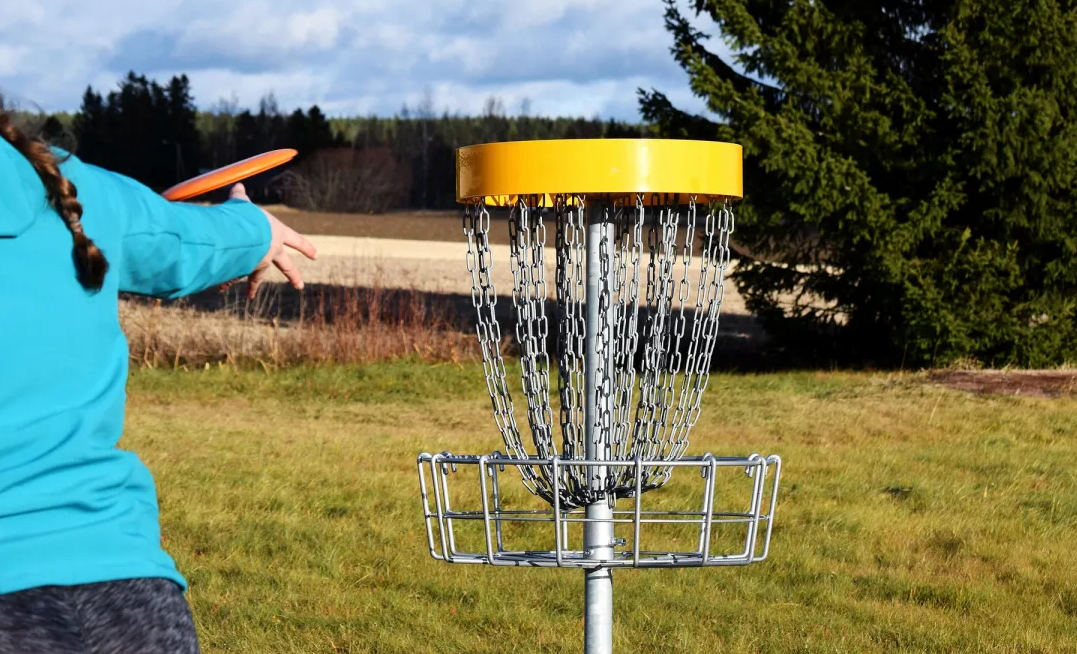
Disc golf follows the basic idea of traditional golf, but players throw flying discs toward metal baskets instead of hitting balls into holes. The aim is to complete each hole in as few throws as possible. You don’t need much equipment to get started, and courses range from beginner-friendly layouts to challenging wooded fairways that test even experienced players.
Most courses have 9 or 18 holes, each presenting different distances, terrain, and obstacles. Open fairways offer room for longer drives, while wooded holes demand accurate placement and careful shot selection. Players can enjoy casual rounds with friends, practice individually, or enter organized competitions.
What Is Disc Golf?
Disc golf is an outdoor target sport in which players throw specialized discs from a teeing area toward a basket fitted with hanging chains. After the opening drive, play continues from where the disc comes to rest until it reaches the target. Each throw counts toward the player’s score, along with any penalties.
The sport became more organized during the 1970s with the introduction of purpose-built baskets and standardized equipment. Today, the Professional Disc Golf Association (PDGA) maintains the official competitive rules and sanctions tournaments. Local clubs also organize events, maintain courses, and introduce newcomers to the sport.
Success depends on controlling the disc’s flight, choosing suitable throwing angles, and navigating obstacles. Players must consider the shape of the fairway and where they want their next throw to begin, rather than simply aiming directly at the basket.
Courses typically feature marked tees, fairways, baskets, and signs displaying hole distances and layouts. Many public courses are free, although some parks and private facilities charge a fee to play.
How to Play Disc Golf
Each hole follows a simple sequence: tee off, continue throwing from where the disc comes to rest, and finish when the disc legally enters the basket and remains supported by the target. Players repeat this process across the course, keeping track of their throws and penalties.
Beginners can complete their first round with a putter or neutral midrange disc. Learning how to play disc golf is largely a matter of understanding where to throw from, when a hole is complete, and how to keep score.
Starting a Hole
Every hole begins at a designated teeing area. The opening throw, known as the tee shot, should advance the disc toward the basket while avoiding trees, water, and other obstacles.
The player with the lowest score on the previous hole normally throws first on the next tee. Ties are resolved by comparing scores on earlier holes. For the opening hole, players can agree on an order or use another fair method.
After everyone has teed off, the player farthest from the basket generally throws next. Other players should stay clear of the throwing area and avoid crossing the disc’s potential flight path.
Playing From the Lie
A lie determines where the next throw must be made. For a marked lie, the player must release the disc with at least one supporting point within a rectangular area measuring 20 cm wide and 30 cm deep, directly behind the rear edge of the marker. No supporting point may be closer to the target than the rear edge of the marker at the moment of release.
Players may use the previously thrown disc as their marker or place a mini marker against its front edge before lifting it. A mini is particularly useful when the player wants to throw the same disc again.
Shot selection depends on the distance and obstacles ahead. Backhands suit many drives and approaches, while forehands offer alternative angles around trees. Near the basket, accuracy and distance control become especially important.
Completing a Hole
A hole is complete when the disc enters the target above the tray and below the chain support, then comes to rest supported by the tray or chains. Hitting the chains without remaining supported by the target does not count. A disc that bounces out must be played again from its next lie.
Players record their total throws and any penalty strokes before moving to the next hole. Casual groups may agree on simplified procedures, but sanctioned tournaments follow the official PDGA rules.
Disc Golf Rules and Scoring
The basic disc golf rules are easy to understand, although competitive play includes detailed requirements for marking lies, handling obstacles, and assessing penalties. The PDGA rulebook provides the standards used in sanctioned events.
How Scoring Works
Each throw adds one stroke to the player’s score. Penalty strokes are included in the hole total. Every hole also has a designated par, representing the number of throws an expert player is expected to need under normal conditions.
| Term | Meaning |
| Ace | Completing a hole in one throw |
| Birdie | One stroke under par |
| Eagle | Two strokes under par |
| Par | Completing the hole in the designated number of strokes |
| Bogey | One stroke over par |
| Double bogey | Two strokes over par |
On a par-3 hole, finishing in two throws is a birdie, while taking four produces a bogey. Par is a scoring benchmark, not a limit on the number of throws allowed. Players must complete the hole even if they have already exceeded par.
Scores can also be expressed relative to par. Finishing three strokes below the course’s total par produces a score of -3, while finishing five strokes above par gives +5. In standard stroke play, the player with the fewest total strokes wins.
Out-of-Bounds Areas and Penalties
Roads, bodies of water, property boundaries, and other marked locations may be designated out-of-bounds (OB). A disc is OB when it is clearly and completely surrounded by an out-of-bounds area. The boundary line itself is considered part of OB.
Under standard PDGA rules, an OB throw adds one penalty stroke. Players can generally return to their previous lie or establish a new lie near the point where the disc last crossed into OB, following the applicable marking rules. Tournament instructions may also provide a drop zone or additional restrictions.
Other common situations include:
- Lost disc: After an unsuccessful three-minute search, the player receives one penalty stroke and normally throws again from the previous lie.
- Mandatory route: Some holes require the disc to pass a marked obstacle on a particular side. If a disc crosses a restricted plane associated with a mandatory route, the player receives one penalty stroke and continues from the designated drop zone or another lie allowed by the rules.
- Stance violation: Throwing without a legal stance results in a penalty stroke when the violation is properly called and confirmed under the rules.
- Hazard area: A disc landing in a designated hazard incurs a penalty stroke, but play generally continues from its established lie rather than using ordinary OB relief.
Players should check course signs and tournament instructions for local boundaries, mandatory routes, and drop-zone requirements before starting.
Putting Rules
The official putting area extends 10 meters from the target, measured from the rear edge of the marker disc to the base of the target.
Inside the 10-meter putting area, players must demonstrate full control of their balance behind the marker before advancing toward the target. Stepping or falling forward before establishing balance constitutes a stance violation.
Outside the 10-meter circle, players may follow through beyond their lie after releasing the disc, provided their stance was legal at the moment of release.
Disc Golf Equipment and Disc Types
Disc golf for beginners requires little equipment. Although a single disc is sufficient for recreational play, carrying different models gives players more options for various distances, obstacles, and shot shapes.
Types of Disc Golf Discs
Disc golf discs vary in rim design, speed, glide, and flight stability. Unlike ordinary recreational flying discs, each category is designed for particular throwing conditions.
| Disc type | Main purpose | Characteristics |
| Distance driver | Maximum distance | Wide rim, high speed rating, requires greater throwing speed |
| Fairway driver | Controlled longer throws | Narrower rim, generally easier to control |
| Midrange | Approaches and shorter drives | Moderate speed, versatile flight |
| Putter | Short approaches and putting | Low speed, usually deeper rim and predictable finish |
Manufacturers commonly use four flight ratings: speed, glide, turn, and fade. Speed describes the relative throwing speed a disc is designed for, while glide indicates its tendency to stay airborne. Turn refers to high-speed movement during flight, and fade describes the disc’s finishing movement as it slows.
These characteristics are usually expressed through numerical ratings. Speed commonly ranges from 1 to 14, while glide is typically rated from 1 to 7. Turn often uses values from +1 to -5, with more negative numbers indicating a greater tendency to turn during high-speed flight. Fade is commonly rated from 0 to 5, with higher values indicating a stronger finishing movement.
These numbers are useful for comparing models, but they are not standardized measurements across all manufacturers. Release angle, arm speed, wind, and disc wear can substantially change the actual flight.
Choosing Your First Discs
A good starter set consists of three discs: a putter, a neutral midrange, and an understable or neutral fairway driver.
The putter handles short approaches and shots at the basket. A midrange works well for controlled drives and approaches, while a fairway driver provides additional distance once the player develops consistent technique. High-speed distance drivers are usually less forgiving for beginners because they need greater throwing speed to achieve their intended flight.
Weight also affects handling. Lighter discs may be easier to accelerate but can react more noticeably to wind. Heavier models sometimes provide a steadier feel, although their flight characteristics depend on more than weight alone.
Grip comfort matters just as much as flight ratings. Learning how a small selection of discs behaves at different release angles is more useful than immediately buying a large collection.
Baskets, Courses, and Accessories
A standard disc golf basket consists of a central pole, hanging chains, and a lower tray that catches the disc. Permanent targets are installed on established courses, while portable baskets allow players to practice at home or in suitable open spaces.
Hole lengths vary from short technical challenges to long championship-level fairways. Elevation changes, narrow gaps, and obstacles influence which shots are practical.
Useful accessories include a disc bag, towel, mini marker, water bottle, and shoes with reliable traction. A towel helps maintain grip in damp conditions, while suitable footwear is important on muddy slopes and uneven ground.
Basic Throwing Techniques for Beginners
A consistent throw starts with a balanced stance, comfortable grip, and smooth acceleration. Beginners benefit from practicing different release angles and learning how the disc responds before attempting longer, more demanding shots.
Backhand Throw
The backhand is among the most common disc golf techniques. For a right-handed player, the disc moves across the body as the hips and shoulders rotate toward the throwing direction.
To practice a basic backhand:
- Stand sideways to the target with your feet comfortably apart.
- Grip the disc firmly without creating unnecessary tension in your arm.
- Rotate your shoulders and extend the throwing arm backward in a controlled motion.
- Shift your weight toward the front leg while bringing the disc forward.
- Release at the intended angle and allow your body to follow through naturally.
A clean release helps the disc maintain its intended flight. Throwing with the nose tilted excessively upward can cause it to climb, stall, and fade early.
The angle of the disc at release also affects its path. A hyzer release can help shape a controlled fading shot, while an anhyzer release can produce a turning flight or a wider curved line, depending on the disc’s stability and throwing speed.
Forehand Throw
The forehand, or sidearm, uses a different grip and arm motion. Players typically place one or two fingers against the inside rim and accelerate the disc with a sideways throwing action.
This technique is useful when obstacles make a backhand line difficult. For a right-handed player, a stable forehand generally finishes to the right, while a right-handed backhand tends to finish left.
A compact motion, good timing, and smooth acceleration help prevent the disc from wobbling. Trying to generate all the power through an abrupt wrist snap often makes the release less consistent.
Putting and Short Approaches
Putting requires a repeatable motion, stable footing, and precise distance control. Two common methods are spin putting and push putting.
Spin putting uses wrist action to generate rotation and forward speed. Push putting relies more on an upward and forward arm movement, typically producing a softer flight with less spin.
Neither style suits everyone. Players can experiment with both before settling on a technique that works reliably for them.
For short approaches, the objective is usually to leave a comfortable next putt. Choosing a controlled flight and suitable landing area reduces the risk of sailing past the basket.
Common Beginner Mistakes
Poor timing is a frequent problem among new players. Trying to throw at full power can cause early releases, inconsistent angles, and loss of balance. Practicing with a slower, deliberate motion makes it easier to identify problems with grip, footwork, and release timing.
Another mistake is overlooking the landing area. A direct line toward the basket is not always the best choice, especially when trees, slopes, or OB boundaries make an aggressive shot risky.
Wind also affects disc flight. A headwind can make a disc behave more understable, increasing its tendency to turn. A tailwind often makes the disc behave more overstable, causing it to fade sooner. Practicing in different conditions helps players understand these effects and choose appropriate shots.
FAQ
Is disc golf difficult to learn?
The basic rules are simple enough for most beginners to complete a recreational round without extensive preparation. Developing accurate drives, reliable approaches, and consistent putting takes more practice, particularly on wooded or technically demanding courses.
How many discs do you need to play disc golf?
One disc is sufficient for a casual round. A neutral midrange or putter makes a practical first choice. As players improve, they can add discs suited to longer drives, different flight paths, and specialized approaches.
What is the difference between disc golf and Frisbee?
Disc golf is a target sport played on courses with designated tees and baskets. Frisbee is commonly used as a general term for recreational flying-disc activities. Disc golf discs are typically smaller, denser, and designed for specific flight characteristics rather than casual throwing and catching.
How long does a round of disc golf take?
A nine-hole round often takes 30–60 minutes, while an 18-hole round may require 1.5–3 hours. Course length, terrain, group size, experience, and congestion all influence playing time.
What does hyzer mean in disc golf terminology?
Hyzer describes a release angle where the edge of the disc opposite the gripping hand is tilted downward. Anhyzer refers to the opposite tilt. Both angles are used to shape shots around obstacles, although the resulting flight also depends on disc stability and throwing speed.
Can you play disc golf in the rain?
Yes, provided the course remains open and conditions are safe. Wet discs can be difficult to grip, and muddy terrain increases the risk of slipping. Carrying a towel, wearing shoes with good traction, and avoiding unsafe weather conditions make rainy rounds more manageable.