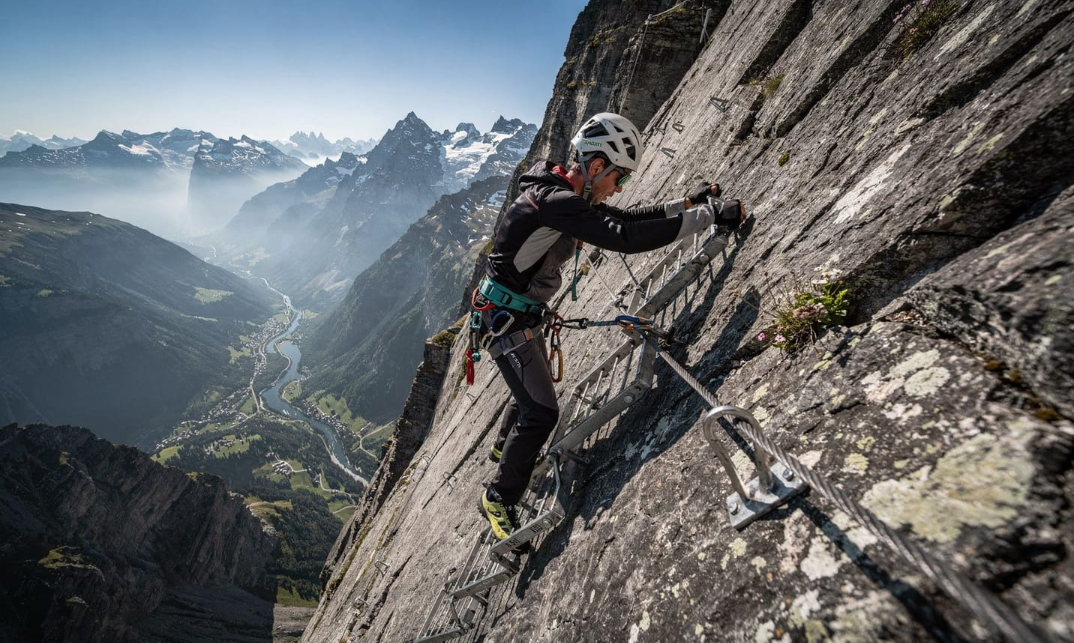
Via ferrata lets you explore steep mountain terrain without the technical skills required for conventional roped climbing. These protected routes follow rock faces, ridges and exposed ledges, using fixed steel cables, metal rungs, ladders and sometimes suspension bridges. Climbers wear a harness connected to the safety cable through a dedicated via ferrata set.
Routes vary widely in difficulty and exposure. Some involve short climbs with natural footholds and easy access, while others feature vertical walls, overhangs and sections where retreat is difficult. Choosing a route within your abilities, carrying the right equipment and understanding how the protection system works are essential for a safe outing.
What Is Via Ferrata and How Does It Work?
The Italian term via ferrata means “iron path”, a reference to the permanent metal fixtures installed along these mountain routes. Although protected climbing routes existed earlier, via ferrata became widely associated with the military routes constructed in the Dolomites during World War I. Today, most routes are used for recreational climbing.
A typical route combines natural rock features with artificial aids. Metal rungs provide footholds on steep or smooth surfaces, while ladders help climbers negotiate vertical sections. Fixed safety cables provide attachment points for via ferrata lanyards. Some routes also feature exposed traverses, narrow ledges and suspension bridges.
Climbers connect two lanyard arms to the safety cable using specialized locking carabiners. At intermediate anchors, they transfer the carabiners individually, keeping at least one attached throughout the transition.
The system is designed to arrest a fall and limit the forces involved, rather than prevent someone from slipping. Unlike a top-rope setup, via ferrata lanyards normally remain slack during movement. A fall may therefore involve a considerable drop before the equipment arrests it, with a risk of striking the rock or fixed metal structures.
Via ferrata routes exist throughout Europe and other mountain regions. The Italian Dolomites and Austrian Alps are particularly well known, offering everything from introductory climbs to long, demanding alpine routes.
Via Ferrata vs Traditional Rock Climbing
Both activities involve climbing steep rock, but they differ in equipment, protection and the skills needed to progress.
Conventional roped climbing relies primarily on natural rock holds. Depending on the discipline, climbers place removable protection or clip their rope into fixed bolts. Belaying, rope management and climbing technique are central to the activity.
Via ferrata routes already have fixed protection and climbing aids installed. Climbers normally move without a conventional climbing rope, although guides may provide an additional rope belay for children or less experienced participants.
| Feature | Via Ferrata | Traditional Rock Climbing |
| Route protection | Fixed steel cables and anchors | Removable protection or fixed bolts |
| Movement | Natural holds, rungs, ladders and cables | Primarily natural rock holds |
| Main safety equipment | Harness, energy-absorbing via ferrata set and helmet | Harness, rope, belay equipment and suitable protection |
| Technical skills | Correct clipping, anchor transitions and route assessment | Climbing technique, belaying and protection management |
| Physical demands | Moderate to extremely strenuous | Vary widely by route and discipline |
| Fall consequences | Potentially severe due to fall distance and fixed obstacles | Depend on protection, terrain and fall distance |
Via ferrata is generally more accessible to beginners, but easier movements do not necessarily mean lower risk. An exposed traverse can be intimidating even when the footholds are straightforward. Steep ladders and overhanging sections may also require considerable upper-body strength.
The appeal lies in reaching exposed ridges and rock faces without the rope techniques required for conventional climbing. Good fitness, careful route selection and sound judgment are still necessary.
Via Ferrata Difficulty Levels
Via ferrata routes do not follow a single worldwide grading system. Countries and guidebook publishers use different scales, making it important to check which classification applies to a particular route.
In Austria and parts of Central Europe, routes commonly use an A–E scale, sometimes extended to F, with intermediate grades such as B/C or C/D. Italian routes often use F, PD, D, MD and ED, while other regions may follow numerical or local systems.
The A–F scale provides a useful starting point for understanding technical difficulty.
| Grade | Typical Terrain and Demands |
| A | Easy protected paths, occasional ladders and limited technical difficulty |
| B | Steeper passages, frequent cable use and moderate exposure |
| C | Sustained steep climbing, vertical sections and greater physical effort |
| D | Difficult, exposed terrain requiring strength and confident movement |
| E | Very demanding climbing, often with overhangs and sustained arm effort |
| F | Extremely strenuous sections for highly experienced climbers |
These grades describe technical difficulty rather than the complete demands of a mountain outing. A long grade B route at altitude may be more exhausting than a short grade C climb near a road.
When comparing routes, pay attention to several factors beyond the published grade:
- Total duration: Include the approach, protected climbing section and descent.
- Elevation gain: Long ascents can be tiring even when individual climbing moves are easy.
- Exposure: Narrow ledges and open traverses can be challenging for climbers uncomfortable with heights.
- Escape options: Some routes have intermediate exits, while others offer no practical way to retreat.
- Descent terrain: Loose scree, steep trails and unprotected scrambling may demand extra care.
- Weather and altitude: Wet rock, lingering snow, low temperatures and storms can make a manageable route hazardous.
For a first climb, an A or B route on the Austrian scale is usually a sensible choice, provided the approach, descent and overall length are manageable. A short route with straightforward access offers a better introduction than a long alpine itinerary with complicated terrain.
Essential Equipment for Via Ferrata
The essential via ferrata equipment includes a climbing harness, an energy-absorbing via ferrata set and a climbing helmet. Suitable footwear, gloves and weather-appropriate clothing help make the climb safer and more comfortable.
Ordinary hiking equipment is not enough. The personal protection system must be designed to handle the forces generated during a fall on a fixed cable.
Via Ferrata Harness
Most adults can use a standard climbing sit harness, provided it fits securely and is compatible with their via ferrata set.
The waistbelt should sit correctly above the hips, while the leg loops must allow unrestricted movement without being excessively loose. Check the fit when bending, stretching and stepping onto high rungs.
Children may need a full-body harness to maintain a secure fit and suitable body position. Harness selection depends on body proportions and the manufacturer’s recommendations, not simply on the climber’s age.
Via Ferrata Lanyard and Carabiners
A dedicated via ferrata set consists of two lanyard arms, specialized locking carabiners and an energy absorber. The absorber is designed to limit the force transmitted to the climber when a fall is arrested.
Choose equipment certified to the applicable EN 958 standard. Check the manufacturer’s permitted user weight range, including any equipment carried where specified. Standard climbing slings, improvised rope loops and non-energy-absorbing lanyards are not suitable replacements.
Climbers outside the approved weight range, including lighter children, need an appropriate additional rope belay managed by someone trained in the necessary techniques. Setting up this protection requires specific rope-handling and belaying skills; carrying a rope alone does not provide additional safety. Follow the manufacturer’s instructions and seek guidance from a qualified instructor.
Before setting out, inspect your via ferrata gear for worn stitching, damaged lanyards, signs of absorber deployment and faulty carabiners. Equipment showing damage must be assessed according to the manufacturer’s instructions before further use.
Via Ferrata Helmet
A certified climbing helmet protects against falling stones and impacts with rock, ladders or other fixed structures. A bicycle helmet should not be treated as an equivalent substitute.
The helmet should sit level on the head with the chinstrap fastened. Check the shell, straps and adjustment system for cracks, wear or other damage before each outing.
Footwear and Clothing
Approach shoes with grippy soles work well on many routes, providing traction on rock and enough flexibility for precise foot placement. Sturdy hiking boots may be preferable when the approach or descent crosses scree, mud or rough mountain trails.
Gloves help protect the hands from friction against steel cables. Half-finger models offer better dexterity, while full-finger gloves provide more coverage.
Choose clothing that allows free movement and suits the expected temperatures. A lightweight waterproof jacket is useful in mountain environments, where conditions can change quickly.
For longer routes, carry water, food, a compact first-aid kit, navigation tools and a charged phone. Check the route description for any special equipment requirements, such as a compatible pulley for a designated zip-line section.
How to Prepare for Your First Via Ferrata
Your first climb should start with a clear understanding of the route, its demands and the equipment you will be using. Beginners need to develop basic movement skills and recognize conditions that make continuing unsafe.
An introductory session with a qualified guide is a practical way to learn how to attach the lanyards, move efficiently on steep terrain and manage exposed sections. A guided via ferrata for beginners also provides an opportunity to practice cable transitions and proper body positioning under supervision.
Building stamina and balance beforehand makes steep sections easier to manage. Uphill hiking, stair climbing and walking on uneven ground develop endurance, while basic climbing practice improves foot placement and helps you rely more on your legs than your arms.
Choosing a Suitable Route
The best beginner route is not necessarily the shortest. An easy protected climb followed by a difficult, unmarked descent can still make for a demanding outing.
Start with a reliable route description showing the grade, elevation gain, expected duration and access information. Check recent maintenance reports, seasonal closures and any warnings about damaged equipment.
Before setting out, confirm the following:
- Approach and descent: Know where the protected section begins, how to reach it and which trail leads back.
- Route continuity: Identify places where the safety cable ends and ordinary hiking or scrambling begins.
- Resting opportunities: Look for secure ledges or easier sections where you can pause without blocking others.
- Weather exposure: Check whether the climb crosses open ridges or terrain with limited shelter.
- Access restrictions: Confirm whether permits, reservations or a qualified guide are required.
Pay particular attention to the descent. Some via ferrata routes finish far above their starting point, leaving a lengthy walk over uneven ground. Others have exposed sections that remain challenging after the protected climbing is complete.
Safety Rules and Common Mistakes
On exposed terrain, small mistakes with equipment or spacing can have serious consequences. Climbers need to remain attentive to the safety cable, fixed anchors and other participants throughout the route.
Stay attached to the safety cable.
Transfer carabiners one at a time at intermediate anchors, keeping at least one connected while exposed. Follow the manufacturer’s instructions for both lanyard arms, including how to secure an unused arm without interfering with the energy absorber.
Maintain adequate spacing.
Avoid having multiple climbers attached within the same cable span between consecutive anchors. Follow any stricter spacing rules posted on the route, as anchor distances and cable configurations vary. Crowding increases the risk of collisions if someone falls.
Use your legs rather than pulling constantly with your arms.
Place your feet securely on rock or rungs and keep your movements controlled. Gripping the cable too tightly for long periods can exhaust your forearms, especially on steep sections.
Watch for damaged fixed equipment.
Loose anchors, frayed cables, unstable rungs and corrosion are warning signs. Do not rely on visibly damaged protection. Turn back when possible or seek qualified assistance if safe progress is uncertain.
Avoid thunderstorms.
Check the mountain forecast and do not begin a route when thunderstorms are forecast during the expected climbing window. Exposed ridges and steel cables create serious lightning hazards. Wet rock, snow and ice can also reduce traction.
Use resting attachments correctly.
The energy absorber is intended to limit fall-arrest forces, not serve as a general-purpose positioning device. Some via ferrata sets have a dedicated attachment point for resting, which must be used exactly as specified by the manufacturer. Do not improvise a resting connection or assume that every lanyard system supports the same arrangement.
Recognize fatigue early.
Weakening grip, shaking legs and difficulty handling carabiners indicate that tiredness is affecting control. Stop somewhere secure before exhaustion makes climbing movements unreliable.
Avoid falls whenever possible.
During a fall, the carabiners can slide down the cable until they reach an anchor. The energy absorber then helps limit the arrest force, but the climber may still strike rock, rungs or ledges. The system cannot guarantee an injury-free fall.
Check equipment after a fall.
If a fall has loaded the energy absorber, stop using the affected set and follow the manufacturer’s inspection and retirement instructions. A deployed absorber may no longer provide adequate protection.
These precautions reflect established via ferrata safety principles used by alpine organizations and climbing equipment manufacturers. Route-specific instructions and equipment manuals should always take priority over general advice.
FAQ
What is via ferrata, and is it suitable for beginners?
Via ferrata is a protected climbing route equipped with fixed safety cables and metal climbing aids. Beginners can attempt suitable introductory routes, ideally with a qualified guide. Basic fitness, properly fitted equipment and some confidence on exposed terrain are important.
Do you need climbing experience for via ferrata?
Previous rock climbing experience is not essential for easier routes. However, you must know how to use the protection system, transfer carabiners correctly and judge whether a route is within your abilities. Difficult routes demand stronger climbing skills and mountain experience.
What equipment do you need for via ferrata climbing?
The essential equipment includes a climbing harness, an EN 958-certified energy-absorbing via ferrata set and a climbing helmet. Grippy footwear, gloves, suitable clothing and basic mountain supplies are also recommended. All equipment must fit correctly and be used within its specified limits.
How difficult are via ferrata routes?
Difficulty ranges from easy protected paths to steep, overhanging climbs requiring considerable strength and technique. Grades vary by region, and the technical rating does not account for every challenge. Route length, elevation gain, altitude and descent conditions also matter.
Can you climb a via ferrata alone?
Solo climbing is possible on some routes, but beginners should avoid it. A companion or qualified guide can assist with equipment checks, navigation and emergencies. Remote routes are especially demanding because obtaining help may be difficult.
Is via ferrata safer than traditional rock climbing?
Neither activity is automatically safer. Via ferrata provides permanent climbing aids and fixed safety cables, but falls can involve substantial distances and collisions with metal fixtures or rock. The risks depend on the route, weather, equipment and the climber’s experience.